
Many owners only realise how expensive downtime is when the whole operation stops, so well-defined IT service level agreements for London SMBs are essential for agreeing expectations with your provider and building a reliable managed IT relationship. This guide examines the key metrics, response times, and London-specific factors that shape effective service level management.
What is an IT Service Level Agreement (SLA)?
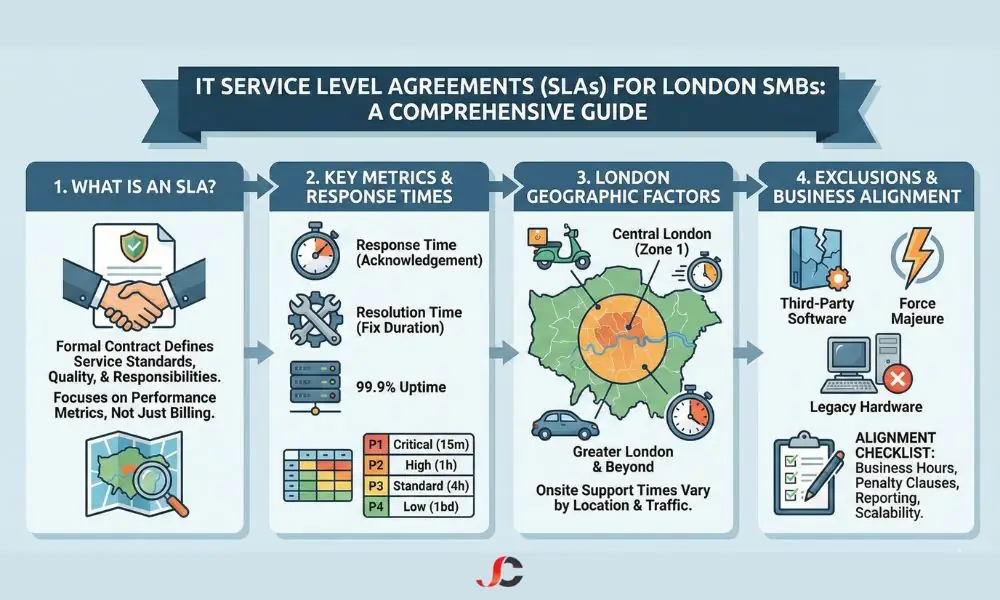
An IT SLA is a written agreement that sets out the service terms between a provider and its client. It outlines the service standards expected, including quality, availability, and responsibilities. A standard contract tends to focus on billing and the duration of the agreement, but an SLA is designed to govern performance. It defines service quality in concrete terms and sets specific benchmarks so everyone knows what success looks like.
For IT service level agreements for London SMBs, clarity is paramount. These documents must eliminate ambiguity regarding how technical issues are handled. Without a well-defined SLA, a business has no recourse if its IT support takes days to respond to a critical failure.
The Difference Between an SLA and a Standard Contract
While the master services agreement establishes the legal framework for the relationship, the SLA serves as the operational rulebook. It details the technical specifics. For example, the contract states that support will be provided, whereas the SLA dictates how quickly it must be delivered.
Key Metrics Every London Business Should Monitor
When evaluating IT service level agreements for London SMBs, you must look beyond the marketing promises and scrutinise the specific metrics proposed. Metric clarity is essential when evaluating comprehensive IT support services to ensure your team remains productive.
- Response Time: The time between when a ticket is logged and when an engineer acknowledges the issue. It is not the time taken to fix the problem.
- Resolution Time: The time actually taken to resolve the issue and restore operations. Note that many providers guarantee response times but only use “reasonable endeavours” for resolution times.
- Uptime Guarantees: This metric indicates the percentage of time your systems are operational. For instance, 99.9% uptime results in roughly 8.76 hours of downtime per year, whereas 99.99% uptime results in only 52 minutes of downtime per year.
- First-Contact Resolution Rate: The percentage of issues resolved at first contact without requiring a follow-up ticket.
Interpreting Priority Levels and Response Times
Strong SLAs do more than record faults; they also prioritise them based on how much they affect the business. For IT service level agreements for London SMBs, a uniform treatment of all incidents is rarely helpful, because a blocked printer does not merit the same response as a downed server.
The following matrix illustrates standard priority levels you should expect:
| Priority Level | Description of Impact | Standard Response Target | Target Resolution |
| Priority 1 (Critical) | Complete system outage with business operations at a standstill. | 15 Minutes | 4 Hours |
| Priority 2 (High) | A key function is affected, but a workaround is available. | 1 Hour | 8 Hours |
| Priority 3 (Standard) | Problem affecting a single user with minimal impact on the broader business. | 4 Hours | 2 Business Days |
| Priority 4 (Low) | Simple service request or minor issue, such as a password reset. | 1 Business Day | Agreed Schedule |
A Priority 1 incident often requires urgent server support to restore critical business functions immediately. If your current provider does not differentiate between a server crash and a software glitch, your business is at risk.
Why Geographic Location Matters for London SLAs
Geography plays a significant yet often overlooked role in IT service level agreements for London SMBs. Most everyday issues can be fixed remotely, but some still need an on-site visit.
- Central London vs. Greater London: Providers based in Central London can usually reach Zone 1 clients faster than those outside the M25.
- Travel Considerations: An SLA should reflect realistic travel times. If your provider is in Reading and you are in Shoreditch, a 1-hour response is unlikely during peak traffic.
- Engineer Availability: Ensure the SLA states the engineer covers your actual operating hours, especially if these differ from standard UK office hours due to international trading.
Standard Exclusions and “Get Out” Clauses
It is equally important to understand what IT service level agreements for London SMBs do not cover. Providers include exclusions to protect themselves from factors outside their control.
Common exclusions include:
- Third-Party Software: Issues caused by software updates from vendors such as Microsoft or Adobe are often excluded from resolution guarantees, though the provider will liaise with the vendor.
- Force Majeure: Disasters like flooding, fire, or an ISP outage are commonly listed as exclusions and therefore do not incur SLA penalties.
- Legacy Hardware: Equipment that is “End of Life” or no longer supported by the manufacturer is usually excluded from SLA targets.
- User Error: Repeat issues caused by staff ignoring usage policies may fall outside the scope of standard support.
Ensuring Your SLA Aligns with Business Goals
Make sure the SLA fits your needs before you sign; IT service level agreements for London SMBs should be tailored.
Consider the following checklist:
- Business Hours: Does the SLA reflect your working hours, or only 9–5?
- Penalty Clauses: Do you get credits or extra service if targets are missed?
- Reporting: Will you get monthly reports showing how the provider performed against the SLA?
- Scalability: Can the SLA be updated as your business grows and you add more users?
Conclusion
Having a transparent, properly structured SLA in place is a strong sign of a competent IT partner and helps keep your business safe from service failures and unnecessary downtime. Clear terms on response times, exclusions, and priorities give your investment a better chance of delivering long-term stability and the robust IT infrastructure support your London business needs to grow.
What is the standard response time for IT support in London?
Standard response times vary by priority. For critical (P1) issues, a 15 to 30-minute response is standard. For low-priority (P4) issues, a delay of up to 1 business day is typical.
What is the difference between response time and resolution time?
Response time is how quickly the service desk acknowledges and begins working on your ticket; resolution time is how long it takes to resolve the issue entirely.
Do IT service level agreements for London SMBs cover hardware replacement costs?
Usually not. The SLA covers the engineer’s time, but you typically pay for the replacement hardware unless hardware-as-a-service is included.
What happens if an IT provider breaches their SLA?
Most SLAs build in service credits on the monthly bill, and if failures continue, you are often entitled to walk away from the contract without a cancellation fee.
Are on-site visits included in standard IT SLAs?
It depends on your contract. Remote-only SLAs are cheaper but bill extra for site visits, while full managed service SLAs usually include unlimited onsite visits for issues that cannot be fixed remotely.
How is “uptime” calculated in an IT service level agreements for London SMBs?
Uptime is given as a percentage; 99.9% over 720 hours still allows about 43 minutes of downtime.
Why do London businesses need specific SLA clauses?
Businesses have to deal with higher rents and the practical hassle of getting engineers on-site, so it makes sense for IT service level agreements for London SMBs to include local clauses that keep response times and support levels realistic.