
International defence contracts involve rigorous data governance. Many United Kingdom businesses find that standard commercial software does not meet United States federal security requirements. To secure these lucrative supply chain positions, you must understand the exact architectural differences in Microsoft cloud environments. Having Office 365 GCC and GCC High explained is a fundamental requirement for any business operating across borders.
The demand for secure collaboration spaces is accelerating. Defence contractors and their international partners face unprecedented scrutiny regarding data sovereignty. This guide strips away standard productivity features to focus strictly on compliance boundaries.
If you seek a general Microsoft Office 365 overview, our standard commercial hub provides that information. In this article, we assess strict data residency, employee screening, and compliance with international regulations to help you make informed architectural choices.
Office 365 GCC and GCC High Explained: Architecture Overview
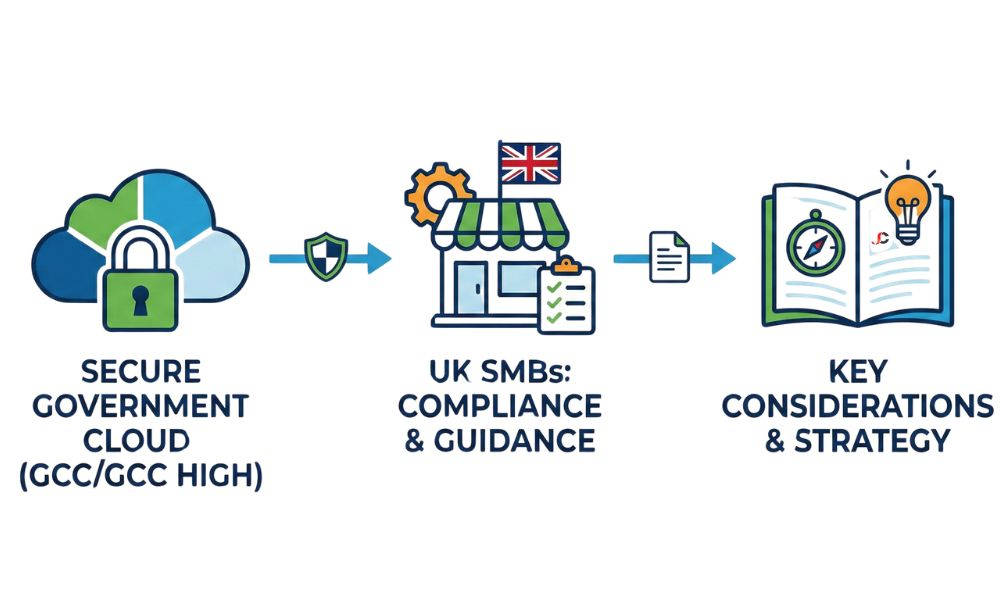
The typical commercial tenants are interested in fast feature delivery and global collaboration. Government environments emphasise isolation, rigorous auditing, and verifiable security. Microsoft designed these isolated platforms for the federal government and their approved contractors. A visual representation of this design will help illustrate the magnitude of the isolation involved.
The fundamental shift means abandoning a globally distributed network. Data within these secure enclaves remains geographically restricted at all times. Microsoft guarantees that only rigorously screened personnel can access the underlying physical infrastructure.
The Basics of Government Community Cloud (GCC)
The standard Government Community Cloud provides a moderate level of isolation. It rests upon the commercial infrastructure but utilises a strictly segregated data plane. This means your sensitive regulated data resides separately from general corporate or consumer information.
Personnel managing this environment undergo extensive background checks. It is primarily designed for state and local government entities within the United States. Contractors handling less sensitive, yet still regulated, information often find GCC sufficient for their baseline compliance needs.
Understanding Maximum Security Environments
GCC High represents a massive architectural departure from standard deployments. It exists within its own distinct physical data centres. It utilises entirely separate identity infrastructures and authentication endpoints to ensure absolute isolation.
This environment was built to meet the stringent requirements of the United States Department of Defence (DoD). This tier is generally required for UK contractors with CUI-handling obligations or ITAR-related compliance constraints. The physical and logical separation guarantees maximum data sovereignty for highly classified supply chains.
Key Differences Between Commercial, GCC, and High-Security Enclaves
Understanding the exact boundaries between these platforms dictates your procurement strategy. A standard commercial tenant routes data globally to ensure maximum efficiency and uptime. A secure enclave restricts data movement entirely to maintain legal compliance.
The matrix below outlines the fundamental differences between the three environments. You must map your specific regulatory obligations to these exact capabilities before attempting a migration.
| Feature Category | Standard Commercial | GCC (Government Community Cloud) | GCC High |
| Infrastructure | Global network | Segregated data plane on a commercial network | Completely isolated data centres |
| Data Residency | Regionally selectable | United States only | United States only |
| Support Personnel | Global support staff | Screened US persons | Screened US citizens with clearance |
| Compliance Targets | GDPR, ISO 27001 | FedRAMP Moderate, CJIS | FedRAMP High, ITAR, CMMC Level 2+ |
| Identity Management | Microsoft Entra ID | Microsoft Entra ID | Microsoft Entra ID (Government) |
Data Residency and Compliance Standards
Data sovereignty remains the primary driver for environment selection. When a London-based aerospace manufacturer bids for foreign defence contracts, standard European data-handling procedures do not apply. You must align with the specific security framework dictated by the prime contractor.
Organisations must often map these US-centric frameworks to local equivalents to maintain holistic security. Securing your perimeter in line with the NCSC's 14 Cloud Security Principles provides a strong foundation for any British firm. However, GCC High ensures your highly regulated data never leaves the required geographical boundaries, satisfying international auditors.
Feature Availability and Limitations
Enhanced security inevitably creates a lag in feature deployments. Do not expect zero-day access to new communication tools or interface redesigns. Microsoft rigorously tests and audits every single application before introducing it to secure enclaves.
Administrators must prepare for upcoming support changes across the platform. Third-party integrations that function seamlessly in commercial environments often fail in isolated networks. Evaluating the 2026 updates for compliance auditing tools is critical for long-term strategic planning and budget allocation.
Why UK SMEs Might Require High-Level Isolation
The global nature of the defence supply chain pulls international businesses into foreign regulatory spheres. A bespoke engineering firm in the United Kingdom may design a single component for a larger military vehicle. That single component dictates the firm’s entire data security posture.
If the prime contractor requires adherence to the Cybersecurity Maturity Model Certification (CMMC), commercial tenants fail immediately. You cannot store export-controlled data in a standard European data centre without violating international law. Upgrading your cloud environment becomes a mandatory cost of doing business.
These environments are not reserved exclusively for massive enterprise corporations. Small and medium-sized enterprises (SMEs) frequently handle highly sensitive schematics, technical data, or financial records. Protecting that data requires enterprise-grade isolation regardless of your company headcount.
Licensing After Upgrade
Transitioning to a secure enclave is not a simple administrative toggle. Microsoft heavily regulates access to these platforms to prevent unauthorised entities from entering the secure network. You must pass a rigorous validation process to view pricing.
Once Microsoft validates your organisation, the procurement method changes entirely. You cannot purchase these licences via standard web portals or typical corporate resellers. You must work with approved licensing providers who specialise in complex government deployments.
Managing your Microsoft 365 subscriptions requires careful auditing after this transition is complete. Users migrating from commercial platforms may need different licensing levels to ensure basic functionality is maintained. It is important to map your legacy operational needs to the new environment.
Planning Your Migration and Security Framework
Migrating data into an isolated environment demands meticulous technical planning. You are moving from a globally accessible platform into a highly locked vault. The pathways in and out are strictly controlled by design.
Tenant-to-tenant migration is notoriously complex in this scenario. You cannot drag-and-drop mailboxes across secure boundaries. The process requires specialised third-party migration tools from approved vendors, such as AvePoint, to map legacy data structures into the new tenant without causing compliance breaches.
To break down the technical planning, administrators must secure three critical areas before initiating any data transfer:
- Identity Management: GCC High uses a distinct Microsoft Entra ID structure. Your current user credentials will not seamlessly migrate over without specialised migration tools and careful synchronisation protocols.
- Perimeter Security: Implementing Microsoft Defender for Office 365 ensures your inbound and outbound communications meet stringent compliance rules. You must configure threat policies to match the exact regulatory framework governing your international contracts.
- Access Controls and Data Loss: Access control lists must be rewritten in their entirety to adopt a zero-trust model. You must define exactly which types of sensitive data are permitted to leave the environment so that leaks can be automatically stopped.
Final Thoughts on Cloud Isolation
Obtaining global defence contracts requires unswerving data protection. General-purpose productivity software will not meet the high standards of today’s military logistics chains. Having the meaning of Office 365 GCC and GCC High clarified is the starting point of your continuous compliance process. You must conduct an immediate audit of your existing data flows and bring them into compliance with the necessary regulatory environments.
The transition requires expert planning and flawless execution. Engaging professional Office 365 migration services ensures your sensitive data moves securely into the new enclave without spillage. If you require guidance on eligibility or architectural design, our Office 365 consultancy team can map your exact operational requirements. Do not risk your most valuable contracts on inadequate cloud architecture.
What is the difference between Office 365 Commercial and GCC?
While commercial tenants share global infrastructure to maximise performance, GCC segregates the data plane and guarantees that only thoroughly screened personnel manage the underlying servers.
Can a UK-based organisation use Microsoft GCC High?
UK-based organisations can use this environment if they have a valid sponsor letter from a US government agency or prime contractor that demonstrates direct involvement in regulated supply chains.
Does GCC High include all standard Office 365 applications?
While fundamental software such as Word and Exchange remains usable, third-party integrations and communication are severely limited to prevent data compromise.
How do we validate our eligibility for a GCC environment?
Organisations are required to make a direct application to Microsoft with corporate identifiers and contracts that securely require the handling of data.
Are GCC and GCC High hosted on the same servers?
GCC utilises partitioned space on the standard commercial network, whereas GCC High operates within physically separate data centres using entirely isolated infrastructure.
Will my current third-party integrations work in GCC High?
You will likely need to source alternative government-approved applications because third-party integrations must meet the same rigorous compliance standards to connect to the isolated environment.
How does data residency work for UK companies in GCC High?
Your regulated data must reside exclusively within the United States to satisfy ITAR or CMMC requirements, requiring careful checks against local UK data sovereignty laws regarding your internal employee information.
Can we operate a hybrid environment with both Commercial and GCC tenants?
Many organisations successfully maintain dual tenancies, using the commercial side for standard communications while strictly reserving the high-security enclave for personnel handling regulated contract data.