
Selecting an IT support contract is as much a budgeting decision as a technical one. The model you choose determines whether IT becomes a predictable monthly line item or an unpredictable series of invoices. This guide compares IT support pricing models for UK businesses and evaluates each model on cost control, not just features. For the full scope of provision, see our IT support services.
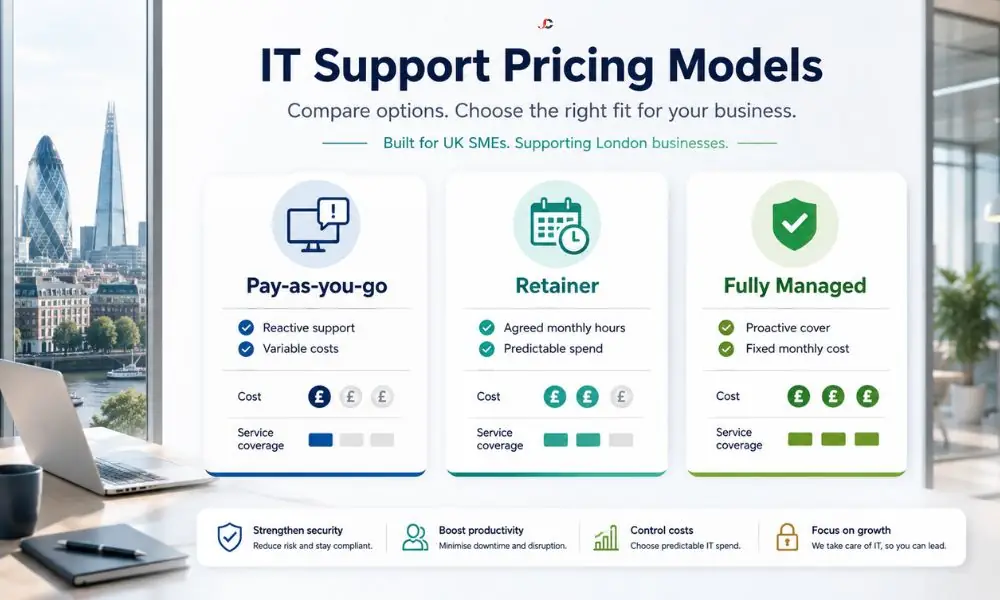
Key Takeaways
- Three core models dominate the UK market: pay-as-you-go, retainer, and fully managed support, ordered from least to most predictable in cost.
- Fully managed pricing converts IT into fixed OPEX: a single per-user or per-device fee replaces variable callout charges and stabilises cash flow.
- The lowest hourly rate rarely means the lowest total cost: reactive break-fix support carries downtime, emergency premiums, and unbudgeted project fees.
- The right model depends on three variables: headcount, reliance on technology, and sector compliance risk, particularly for finance, legal, and recruitment firms.
What are the main IT support pricing models?
There are three primary models that UK companies can use to bill for IT support services. These are pay-as-you-go (ad-hoc), retainer, and fully managed. The models differ not only in their billing structure but also in the level of cost predictability they provide.
Such classification corresponds directly to a company’s dependency on technology. A business with few minor problems falls into one category, while a growth-oriented firm facing regulatory challenges finds itself on the other end of the spectrum. Comprehending both classifications serves as the basis for comparing any IT support pricing models.
How does pay-as-you-go IT support work?
IT support on an ad hoc basis, sometimes referred to as pay-as-you-go support, involves paying for the number of hours used without a contract. This type of service applies to micro-businesses with a basic IT infrastructure that has minimal issues but lacks monitoring.
Appeal is the low cost of the services offered, coupled with a lack of contract. The risks involved include exposure. One major disruption can result in an unexpectedly high bill, while repeated problems will go unmanaged due to a lack of post-service system surveillance.
What does a retainer IT support contract include?
Under the retainer agreement, you purchase support time blocks for the coming months at a negotiated price. This service falls between ad hoc and managed support services. The expense is variable; however, the response time increases.
For those organisations that can predict their support requirements, retainer models may be more suitable. While they cost more than break-fix, hour monitoring remains important for the finance department to prevent overage fees.
What is the pricing for fully managed IT support?
The managed IT services cost remains constant because a fixed monthly charge covers everything. All these aspects are covered under a set scope of work, which means that you know what you will pay monthly, regardless of how many problems arise.
This is the model most aligned with budget certainty. Providers absorb demand variability, which is why fully managed IT contracts are favoured by firms that depend heavily on uptime.
How do IT support pricing models compare side by side?
As can be seen across the three models, predictability and coverage are positively correlated, whereas billing shifts from reactive to fixed. With pay-as-you-go, there is no commitment, but it offers the least predictability, whereas fully managed services offer maximum coverage and predictability.
| Dimension | Pay-as-you-go / ad-hoc | Retainer | Fully managed |
| How it works | Pay per incident or hour | Pre-purchased block of hours | Fixed monthly fee, all-inclusive |
| Billing basis | Variable, reactive | Semi-fixed | Fixed per user or device |
| Cost predictability | Low | Medium | High |
| Accounting treatment | OPEX, irregular | OPEX, smoother | OPEX, fully smoothed |
| Proactive monitoring | None | Limited | Included |
| Best for | Micro-firms, rare issues | Stable, light reliance | Growth, high reliance, compliance |
| Typical commitment | None | Rolling | 12 months or more |
For organisations weighing these options against in-house provision, our IT consultancy services can model the total cost of each route.
Why does OPEX versus CAPEX matter for your IT support budget?
The costs incurred for IT support fall under OPEX (operating expense). They are repetitive and can be deducted from the books in the period in which they are incurred, without any initial capital investment. CAPEX (capital expenditure) involves tying up cash in capital investments, which can be recovered over time.
A service-oriented approach will ensure that IT remains OPEX, which finance directors prefer. Capitalised assets are instead relieved over time; HMRC guidance on capital allowances sets out that treatment.
The benefit OPEX offers SMEs is straightforward. There are no substantial upfront costs or fixed monthly payments, and you can spend in accordance with your workforce rather than invest in depreciating assets. You need to consult your accountant regarding your situation.
How does fully managed pricing smooth and predict IT spend?
A fully managed pricing approach helps reduce fluctuations in IT expenses because, instead of paying for services based on demand, there is a single flat price regardless of whether there are two incidents or twenty throughout the month.
Predictability also helps plan for other needs besides helpdesk support. Having a fixed amount for IT services will make budgeting easier going forward. Proactive infrastructure management reduces the failures that drive surprise costs in the first place.
The cash flow effect accumulates over the year. With fixed monthly billing, IT costs are aligned with revenue, enabling better forecasting without the quarter-distorting effects of ad hoc support.
Which IT support pricing models suit your London business?
The key considerations for the best option are the number of heads involved, the degree of reliance on technology, and the degree of regulation. The occasional needs of micro-firms with very few incidents can be managed through an on-call arrangement. At the same time, the retainer agreement suits organisations that are growing and need a certain level of coverage.
Data security and continuity become more important for financial, legal, and recruitment companies based in London. In cases such as these, the active monitoring and timely responses that come with a managed contract are more than just convenient — they enable compliance and help avoid downtime costs.
Growth is the other deciding factor. A per-user managed fee scales cleanly as you hire, whereas break-fix exposure grows unpredictably with every added device and user.
What hidden costs should finance leaders watch for?
It is important to note that the actual cost of operation may not necessarily be reflected in the quoted headline rate. Costs can be hidden in three major categories: extra charges for services not covered by a particular contract, unproductivity due to downtime in reaction-type processes, and after-hours costs.
Finance leaders should scrutinise the contract scope before comparing prices. Useful questions to put to any provider include the following.
- Out-of-scope rates: what work falls outside the monthly fee, and how is it charged?
- Response and resolution SLAs: are target times contractual, and what applies if they are missed?
- Onboarding and exit fees: are there setup charges or costs to leave at the end of the contract?
- Project work: Are migrations and upgrades quoted separately, and on what basis?
Disciplined cost control extends to the cloud layer too; our cloud cost optimisation work removes waste that support contracts alone do not address.
How do you move from unpredictable to predictable IT costs?
Getting to predictable IT costs involves auditing the actual amount spent over the previous year, accounting for emergency support and reduced productivity. Then compare that amount to a flat fee compared to an hourly rate. All companies realise that a predictable approach is cost-effective when considering overall expenses.
Transition is easy – measure your current spending, assess the required scale, and adopt the structure that best fits your dependencies and risks. To get a structural analysis based on your figures, you can contact us without any obligation.
What is the average cost of IT support per user in the UK?
Prices depend on the extent and the party offering the service, which is usually offered per user per month. Instead of looking for a single number, consider what the fee covers, since a higher inclusive price may end up cheaper than a lower price that adds extra costs.
Is pay-as-you-go IT support cheaper than a managed contract?
The hourly charge may seem cheaper, but it becomes more costly once you consider other factors, such as downtime and emergency charges. If an organisation needs IT services regularly, it is better to opt for a fixed price.
Can the IT support cost be treated as an operating expense?
Yes, IT support costs are recurring and expensed as incurred, since they are considered operational costs. These differ from the hardware cost that is capitalised. Consult your accountant for verification.
What is typically included in a fully managed IT support fee?
A typical fully managed fee will include helpdesk support, proactive monitoring, patch management, maintenance services, and endpoint protection. Project services and migrations are typically quoted separately, so be sure to know where the scope stops.
What is the difference between a retainer and a fully managed contract?
Under the retainer contract, support hours are paid in advance in fixed units, while surplus hours are charged separately. Nevertheless, in outsourcing, all applicable support services are charged uniformly regardless of the volume.
Do fully managed IT contracts require a long tie-in?
Terms vary. Standard contract terms usually last a year or more, but rolling terms and non-contracts are also options. Consider the notice and penalty provisions, as well as any tie-ins, compared to the advantages of the flat-rate fee.
How can a small business make IT spending more predictable?
Move from a reactive to a proactive approach by paying a fixed monthly price. You should consider the actual expenses incurred last year when applying the proactive billing strategy and determining your scope. Proactive monitoring minimises unscheduled downtime, while a one-time payment ensures IT expenses are tied to the number of users.
Which IT support pricing models are best for a regulated firm in finance or legal?
A fully managed service is the most appropriate for companies subject to legal regulation. The constant monitoring, guaranteed response time, and built-in security features minimise the risks associated with non-compliance and the costs of downtime.