
A managed service provider recruitment is a single point of control for how a business sources, onboards, and manages contingent—and, if required, permanent—hires across multiple agencies. It is enabled by a Vendor Management System (VMS) to deliver visibility, speed, compliance, and cost control for London SMBs.
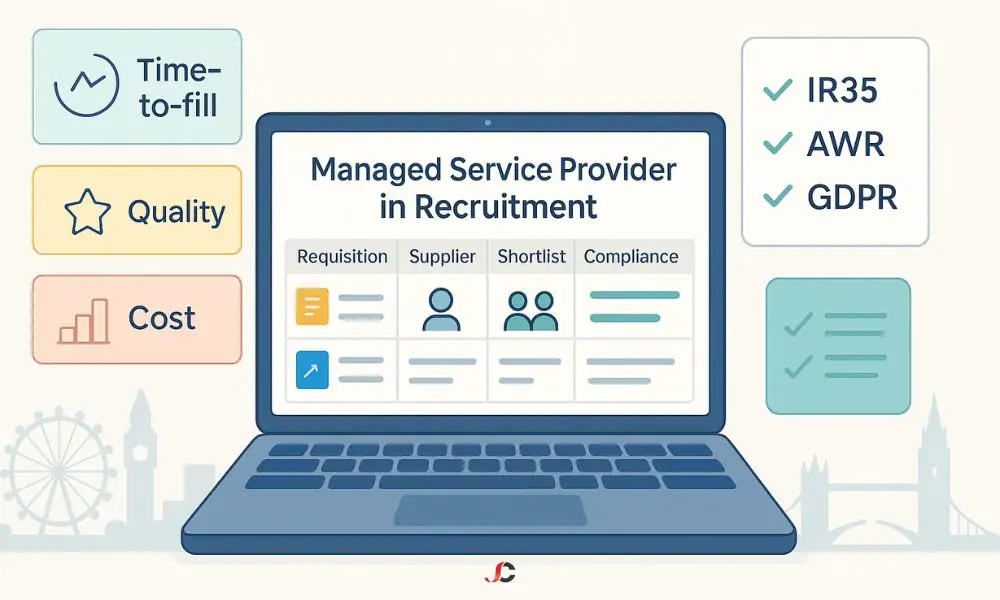
Core elements
- Programme governance: Clear service levels, performance metrics, change control, and stakeholder communication.
- Supplier management: Building and managing the right panel (neutral, master, or hybrid models) to ensure quality and competition.
- Compliance oversight: Embedded checks for IR35, Agency Workers Regulations (AWR), and GDPR, with auditable records.
- Technology (VMS): Centralised workflows for requisitions, approvals, onboarding, timesheets, and invoicing, with real-time dashboards.
- Data and reporting: Management information on spend, time-to-fill, quality, and supplier outcomes to guide decisions.
How it runs day to day
- Requisition: Hiring manager raises a request in the VMS with role details, skills, and budget.
- Distribution: The MSP releases the brief to vetted suppliers with defined timelines and standards.
- Shortlisting: Agencies submit candidates; the MSP curates a shortlist and coordinates interviews.
- Compliance checks: IR35 status, AWR tracking, right-to-work, and GDPR controls are applied before any start date.
- Offer and onboarding: Contracts, background checks, and induction tasks are managed and recorded in the VMS.
- Time and pay: Timesheets and approvals flow through the platform; invoices are consolidated for simpler finance.
- Review and improve: Regular performance reviews refine rate cards, supplier panels, and service levels to ensure optimal performance.
Roles and responsibilities
- Business (e.g., a London SMB): Defines demand, budget, and final hiring decisions.
- MSP: Orchestrates process, enforces standards, manages suppliers, and assures compliance and reporting.
- Suppliers (agencies): Source and present qualified candidates to agreed quality and timelines.
- Workers/contractors: Provide documentation and timesheets through the VMS.
Why UK businesses use this model
- Cost control: Managed service provider recruitment lowers cost by enforcing rate-card governance, using supplier scorecards, and consolidating invoicing to reduce admin.
- Speed and quality: Faster shortlists, better matching, and a smoother candidate experience.
- Compliance assurance: IR35, AWR, and GDPR built into every step, with audit-ready evidence.
- Visibility: Clear data on spend and performance to support better workforce planning.
A well-run managed service provider recruitment gives London SMBs a structured, compliant, and data-led way to hire. With a VMS at the centre, it simplifies supplier management, raises quality, shortens time-to-fill, and provides reliable visibility across the entire hiring journey. For London SMBs, managed service provider recruitment centralises contingent hiring across multiple agencies through a VMS, delivering end-to-end visibility and control.
Which core components should every managed service provider recruitment include?
A well-run managed service provider recruitment brings structure, control, and measurable outcomes to the hiring process. For London SMBs, the following components are essential.
- Programme governance (SLAs, KPIs, change control)
- Service level agreements (SLAs): Clear targets for response times, shortlist speed, and issue resolution.
- Key performance indicators (KPIs): Time-to-fill, candidate quality, compliance pass rate, supplier performance, and hiring manager satisfaction.
- Change control: A simple, recorded process for updating scope, rate cards, workflows, and policies.
- Escalation and cadence: Named owners, an escalation path, and a regular cycle of operational and executive reviews.
- Roles and accountability: A concise RACI so everyone understands who does what and when.
- Supplier management (neutral, master, hybrid)
- Panel recruitment strategy: The right mix of niche and generalist agencies to cover demand without duplication.
- Operating model:
- Neutral vendor: Balanced competition across agencies.
- Master vendor: One lead supplier with second-tier support.
- Hybrid: Combines both to fit different job families.
- Onboarding and due diligence: Checks for capability, insurances, and ethical standards.
- Performance management: Scorecards, quarterly reviews, corrective actions, and clear exit criteria.
- Diversity and reach: Encourages inclusive sourcing while protecting candidate experience.
- Compliance oversight (IR35, AWR, GDPR)
- IR35 (Off-Payroll): Role-based status assessments, documented determinations, and audit trails.
- Agency Workers Regulations (AWR): Automated tracking to the 12-week parity points and accurate pay/benefits alignment.
- GDPR and data protection: Lawful basis, data minimisation, retention rules, and subject rights handling.
- Right-to-work and screening: Consistent pre-employment checks and secure record keeping.
- Continuous monitoring: Regular spot checks and clear remediation steps.
- Data and reporting (spend, time-to-fill, quality)
- Single source of truth: clean data across requisitions, candidates, compliance, and invoicing.
- Operational dashboards: Live views of open roles, funnel progress, bottlenecks, and supplier performance.
- Executive MI (management information): Monthly summaries on spend, savings, quality, and risk.
- Quality-of-hire proxies: Early attrition, first-week no-show rate, and hiring manager feedback.
- Forecasting and planning: Trends by skill, location, and cost centre to support budgeting.
- Technology stack (VMS workflows, approvals, invoicing, analytics)
- Vendor Management System (VMS): Standardised requisitions, approvals, distribution to suppliers, and interview scheduling.
- Compliance automation: Built-in IR35, AWR, and GDPR checks with alerts and audit-ready logs.
- Time and pay: Digital timesheets, approvals, and consolidated invoicing to reduce admin.
- Rate card and controls: Guardrails that prevent off-panel spend and non-compliant rates.
- Integrations: HRIS, payroll, identity (SSO/MFA) for a secure and seamless flow of data.
- Analytics: Custom reports and alerts for exceptions, trends, and savings opportunities.
These core elements ensure that a managed service provider recruitment delivers consistent service, substantial compliance, and clear value. With firm governance, disciplined supplier management, robust oversight, meaningful data, and a capable VMS, London SMBs gain faster hiring, better visibility, and reliable cost control.
Why are London SMBs adopting a managed service provider recruitment right now?
Managed service provider recruitment gives London SMBs tighter control of hiring, better candidate quality, faster turnaround, and clear visibility from request to invoice.
- Cost control
- Rate card discipline: Standard rates and approvals prevent overspend and off-panel hires.
- Supplier consolidation: A curated panel reduces duplication and improves commercial leverage.
- Consolidated invoicing: One set of invoices and fewer errors lowers processing costs.
- Process efficiency: Shorter cycles cut rework and reduce the risk of costly compliance mistakes.
- Quality improvement
- Performance-led panels: Agencies are measured on delivery, retention, and feedback.
- Better briefs, better outcomes: Consistent role templates and screening standards lift match quality.
- Candidate experience: Streamlined communication and fair competition encourage stronger talent to accept offers.
- Built-in compliance: Right-to-work, IR35, AWR, and GDPR checks protect quality and integrity. By standardising briefs, timelines, and feedback loops, managed service provider recruitment improves candidate experience and shortens time-to-fill without sacrificing quality.
- Faster hiring
- VMS automation: Standard workflows move requisitions, approvals, interviews, and offers without delay.
- Ready talent pools: Pre-vetted candidates and priority suppliers speed up shortlisting.
- Clear SLAs: Agreed timelines keep everyone accountable from the first brief to the start date.
- Reduced bottlenecks: Central scheduling and digital signatures remove avoidable waiting.
- End-to-end visibility
- Live dashboards: See open roles, funnel progress, and time-to-fill in one place.
- Spend transparency: Track costs by cost centre, role type, and supplier.
- Compliance status at a glance: IR35 determinations, AWR milestones, and data controls are auditable.
- Supplier league tables: Evidence-based scorecards inform renewals and panel changes.
Choosing a managed service provider recruitment helps London SMBs hire with confidence: controlled costs, stronger candidates, quicker decisions, and reliable management information across the entire hiring journey.
What UK rules must your managed service provider recruitment manage day to day (IR35, AWR, GDPR)?
A managed service provider recruitment should embed UK legal and data protection duties into every step of hiring. For London SMBs, daily compliance is practical, auditable, and repeatable.
- IR35 responsibilities and status determinations
- Early assessment: Evaluate IR35 at requisition stage, based on the role, working practices, and deliverables.
- Status Determination Statement (SDS): Issue a clear, written SDS with reasons, applying “reasonable care”, and recording approvals.
- Dispute pathway: Maintain a formal process to review challenges from workers or suppliers within set timescales.
- Fee-payer duties: Ensure the correct tax route (e.g., PAYE via agency/umbrella where inside IR35) and accurate deductions.
- Change control: Reassess status when scope, power, location, or substitution terms change.
- Audit trail: Store determinations, evidence, and communications for inspection.
- AWR 12-week parity and worker rights
- Day-one rights: Guarantee access to collective facilities and information about vacancies from the first day of assignment.
- Qualifying clock: Track weeks worked per assignment to the 12-week parity point, including breaks and “clock resets”.
- Parity at 12 weeks: Align basic pay, holiday, and key terms with a comparable permanent employee.
- Accurate role data: Keep job titles, grade, hours, and pay elements consistent to support fair comparison.
- Monitoring and evidence: Use system prompts and reports to prove compliance and resolve queries quickly.
- GDPR: lawful basis, minimisation, retention, and DPIAs in recruitment
- Lawful basis: Define and document the appropriate basis (commonly legitimate interests or contract) for processing candidate and worker data.
- Transparency: Provide clear privacy information at collection, covering purpose, retention, and rights.
- Data minimisation: Collect only what is necessary for screening, onboarding, and payment—avoid unnecessary special category data.
- Retention schedule: Apply defined retention periods with secure deletion or anonymisation at the end of life.
- Data protection impact assessments (DPIAs): Conduct DPIAs for high-risk processing (e.g., large-scale screening or new tools).
- Security and access: Enforce role-based access, encryption, and MFA; maintain processor agreements and incident response plans.
- Rights handling: Honour subject rights (access, rectification, erasure, restriction, objection) within statutory deadlines.
By hard-wiring IR35, AWR, and GDPR controls into workflows, a managed service provider recruitment helps London SMBs reduce risk, protect data, and maintain audit-ready records—without slowing down hiring.
What is a VMS—and why does it matter for SMB hiring?
In a managed service provider recruitment model, a Vendor Management System (VMS) serves as the operational hub. It centralises every step of hiring for London SMBs, improves control, and provides the evidence needed for compliance and savings.
- Centralising requisitions
- Standard templates capture role details, skills, rates, and approvals in one place.
- Hiring managers raise requests quickly, with built-in guidance to reduce errors.
- Role changes are version-controlled, creating a clear audit trail.
- Supplier competition
- Briefs are released simultaneously to approved agencies with fair, time-bound deadlines.
- The system compares like-for-like submissions, preventing duplication and off-panel activity.
- Scorecards track delivery, quality, and responsiveness for ongoing panel optimisation.
- Compliance checks
- IR35: Documented status assessments, Status Determination Statements, and change-control prompts.
- AWR: Automated 12-week tracking, parity alerts, and evidence of day-one rights.
- GDPR: Lawful basis, data minimisation, retention schedules, and role-based access baked into workflows.
- Right-to-work and screening records are stored with timestamps and approvals, ensuring accurate documentation and compliance with regulations.
- Consolidated invoicing
- Digital timesheets and approvals flow into a single, accurate invoice cycle.
- Rate-card controls prevent non-compliant billing and off-contract spend.
- Cost centres, purchase orders, and tax breakdowns are aligned to finance needs.
- Dashboards and analytics
- Live views of open roles, funnel progress, time-to-fill, and supplier performance.
- Executive MI highlights spend, savings, risk, and forecasted demand.
- Exception alerts surface bottlenecks, allowing action to be taken before deadlines slip. Data-led dashboards in managed service provider recruitment surface bottlenecks, off-panel spend, and opportunities for direct sourcing to strengthen outcomes.
Why it matters for London SMBs
- Faster hiring through standardised workflows and fewer hand-offs.
- Better quality driven by fair supplier competition and clear feedback loops.
- Lower cost via disciplined rate cards, reduced duplication, and streamlined invoicing.
- Stronger assurance with IR35, AWR, and GDPR controls applied the same way, every time.
A capable VMS turns a managed service provider recruitment into a predictable, auditable, and efficient service—giving London SMBs speed, visibility, and confidence across the entire hiring journey.
What MSP delivery models can UK businesses choose? — Comparison
Managed service provider recruitment can be delivered in several ways. The table below compares the main models for UK businesses, with a focus on what suits London SMBs.
| Model | How it works | Key advantages | Watchouts | Best for London SMBs |
| Neutral vendor | Managed service provider recruitment oversees a balanced panel of agencies; all suppliers compete via the VMS. | Broad market reach; intense competition; transparent performance data. | Requires disciplined panel management; shortlisting may take longer for niche roles. | When you want wide coverage and evidence-based comparisons between agencies. |
| Master vendor | One lead agency fills roles first; unmet demand cascades to a second tier. | Single point of delivery; fast turnaround on typical roles; simple communication. | Over-reliance on one supplier; reduced competition; may limit niche access. | High-volume, repeat roles where speed and simplicity are priorities. |
| Hybrid | Neutral vendor for hard-to-fill roles; master vendor for volume hiring. | Flexibility by job family, competition where it adds value, and speed for routine roles. | Needs clear rules to avoid duplication; stronger governance is required. | Mixed demand profiles need both reach and efficiency. |
| MSP + direct sourcing | Managed service provider recruitment manages agencies and builds a branded talent pool for direct hires. | Lower reliance on agency fees over time, a stronger employer brand, and rapid redeployment of known talent. | Up-front investment in talent community and content; benefits build over time. | Recurring demand in defined skill areas where a reusable talent pool makes sense. |
Quick decision guide
- If reach and fairness matter most, choose a neutral vendor.
- If speed and simplicity are critical for repeat roles, choose a master vendor.
- If your demand is mixed, choose a hybrid.
- If you want to reduce fees and build brand equity, add direct sourcing to your managed service provider recruitment.
Compliance and control checklist (applies to all models)
- Embed IR35 assessments, AWR tracking, and GDPR controls in VMS workflows.
- Set clear SLAs, KPIs, and scorecards to compare supplier outcomes.
- Review panel performance quarterly and adjust the model to fit your hiring pattern and risk profile.
Selecting the right model ensures your managed service provider recruitment aligns with business goals—balancing market reach, speed, cost control, and brand-led talent pooling for London SMBs.
MSP vs RPO: what is the difference—and which fits your hiring needs?
An MSP (managed service provider recruitment) focuses on contingent and temporary hiring across multiple agencies, using a VMS to control process, cost, and compliance. An RPO (Recruitment Process Outsourcing) focuses on permanent hires, embedding dedicated recruiters to manage end-to-end talent acquisition.
- MSP — when it excels
- Scope: Contractors, temps, and statement-of-work engagements across an agency panel.
- Strengths: Cost control through rate cards, supplier competition, consolidated invoicing, and IR35/AWR/GDPR assurance.
- Speed: Fast shortlists for repeat, skills-based demand with pre-vetted suppliers.
- Visibility: Dashboards for spend, time-to-fill, and supplier performance.
- Best for London SMBs: Variable or project-driven demand, tight budgets, and a need for audit-ready compliance.
- RPO — when it excels
- Scope: Permanent roles, workforce planning, employer branding, and talent pipelining.
- Strengths: Embedded recruiters, consistent candidate experience, and more substantial long-term brand presence.
- Quality: Deep role discovery, assessment design, and hiring manager enablement.
- Scalability: Suits steady or predictable permanent intake.
- Best for London SMBs: Planned growth hiring, where permanent retention and cultural fit matter most.
- Key differences at a glance
- Hiring type: Managed service provider recruitment = contingent; RPO = permanent.
- Supply model: Managed service provider recruitment competes with multiple agencies; RPO often acts as the primary or sole recruiter.
- Technology focus: Managed service provider recruitment anchored in a VMS; RPO anchored in an ATS with employer-brand tooling.
- Commercials: Managed service provider recruitment savings from supplier leverage and process control; RPO savings from reduced agency fees and better conversion.
- Compliance lens: Managed service provider recruitment emphasises IR35/AWR operations; RPO emphasises fair hiring, GDPR, and assessment integrity.
- When to blend MSP and RPO
- Mixed demand: You hire both contractors and permanent staff in meaningful volumes.
- Speed + brand: You need a managed service provider recruitment speed for projects and RPO brand building for strategic roles.
- Flexible capacity: Seasonal or project spikes require contingent hiring alongside planned permanent intake.
- Operating model: Managed service provider recruitment manages contingent via VMS; RPO manages permanent via ATS; shared MI, harmonised SLAs, and one governance forum.
- Quick chooser for London SMBs
- Choose MSP if your pain points are off-panel spend, IR35 risk, slow contractor onboarding, or poor visibility of supplier performance.
- Choose RPO if your challenge is scaling permanent hiring with consistent quality and a stronger employer brand.
- Choose both if you need project agility and long-term talent pipelines—set clear swim-lanes and shared metrics.
- Governance and compliance essentials (apply to both)
- Unified oversight: One steering group, agreed SLAs/KPIs, and a single escalation path.
- Data integrity: Consistent reporting across VMS (contingent) and ATS (permanent).
- GDPR by design: Clear lawful bases, retention rules, and role-based access across all platforms.
Select a managed service provider recruitment to master contingent hiring at pace and cost, select an RPO to elevate permanent recruitment and brand, and blend the two when your London SMB requires both agility and long-term capability—all under a compliant, data-led framework.
Which KPIs prove your managed service provider recruitment is working?
The right metrics show whether a managed service provider recruitment is delivering real value for London SMBs. Track these KPIs consistently, segment them by department or role family, and review trends monthly and quarterly.
- Time-to-fill
- What it is: The calendar interval from requisition approval until the offer is accepted.
- Why it matters: Shows process speed and supplier responsiveness.
- How to use it: Trend by role type and seniority; add time-to-start to capture onboarding delays.
- Quality-of-hire indicators
- What they are: Probation pass rate, early attrition (e.g., first 90 days), hiring-manager satisfaction, and time-to-productivity.
- Why they matter: Reveal whether fast hiring still delivers lasting performance.
- How to use them: Pair outcome data with source and supplier to refine the panel.
- Compliance pass rate
- What it is: Percentage of assignments with IR35 status set, AWR tracking active, right-to-work verified, and GDPR steps completed before start.
- Why it matters: Reduces legal and financial risk; essential for audit readiness.
- How to use it: Treat any exception as red; record root cause and remediation within defined timescales.
- Supplier performance
- What it is: Submit-to-interview ratio, interview-to-offer ratio, fill rate, shortlist speed, and SLA adherence.
- Why it matters: Keeps the panel competitive and accountable.
- How to use it: Publish league tables; reward high performers with first look at new briefs.
- Candidate experience
- What it is: Offer acceptance rate, application-to-interview conversion, drop-off rate, and CSAT/NPS after the process.
- Why it matters: A Better experience improves brand reputation and acceptance.
- How to use it: Trigger surveys at key milestones; set SLAs for feedback and updates.
- Cost per hire
- What it is: Total hiring cost (fees, advertising, assessments, internal time) divided by hires. For contingent roles, include rate-card variance.
- Why it matters: Confirms whether savings are real, not just faster cycle times.
- How to use it: Compare on-panel vs off-panel; identify roles where direct sourcing or talent pooling will lower cost.
- Off-contract spend reduction
- What it is: Share of hiring spend routed through the MSP/VMS versus unmanaged routes.
- Why it matters: Controls risk, strengthens data quality, and increases buying power.
- How to use it: Set quarterly targets; require exceptions to be approved and time-bound.
Good practice for KPI governance
- Baselines and targets: Establish last-year baselines; set realistic quarterly improvements.
- Segmentation: View KPIs by business unit, role family, and supplier to find actual bottlenecks.
- Cadence: Weekly operational dashboards; monthly executive MI; quarterly strategy reviews.
- Data quality: Use the VMS as the single source of truth; define owners for each metric.
- Action tracking: Log agreed improvements and report progress at the following review.
When these KPIs move in the right direction—faster cycles, stronger outcomes, cleaner compliance, and lower cost—you have clear evidence that your managed service provider recruitment is working effectively for your London business.
Managed service provider recruitment check: what should be on your UK checklist?
Use this practical checklist to confirm your managed service provider recruitment is set up for strong control, clean compliance, and clear value for London SMBs.
- IR35 status workflow and audit trail
- Role-based assessment at requisition stage, using defined criteria and working practices.
- A written Status Determination Statement (SDS) with reasons and approvals.
- A formal dispute process with documented responses and outcomes.
- Reassessment on scope or control changes, with version history.
- Evidence retention for all decisions, communications, and contracts.
- AWR tracking to 12 weeks
- Day-one rights confirmed and recorded (facilities and vacancy information).
- Automated “qualifying clock” to the 12-week parity point, including rules for breaks.
- Parity checks for basic pay and key terms against a comparable employee.
- Clear records of role data (title, grade, hours, allowances) to support fair comparison.
- GDPR: lawful basis, retention schedule, DPIA, breach process
- Lawful basis documented for each processing activity (e.g., screening, onboarding, payroll).
- Data minimisation by design; only essential data collected and stored.
- A retention schedule with timely deletion or anonymisation at the end of life.
- DPIAs are completed where risk is higher (e.g., large-scale screening or new tools).
- Security controls (role-based access, encryption, MFA) and supplier processor agreements.
- A rehearsed incident and breach response process, with clear roles and timelines.
- Procedures for data subject rights (access, rectification, erasure, restriction, objection).
- Supplier due diligence (insurance, cyber, modern slavery)
- Evidence of professional indemnity, public liability, and employer’s liability insurance.
- Cyber assurance (e.g., recognised certifications) and secure data handling standards.
- Modern slavery statements and ethical recruitment checks.
- Financial health, capability mapping, and diversity and inclusion policies.
- Onboarding pack with contract terms, service levels, and code of conduct.
- Rate card governance and approvals
- Approved rate cards by role family and location, visible in the VMS.
- Exception routing with business justification and time limits.
- Change control covering uplift rules, overtime, and fee structures.
- Regular benchmarking and audit of billed rates versus approved rates.
- VMS configuration (fields, workflows, dashboards)
- Mandatory fields for IR35 status, right-to-work, job family, and cost centre.
- Standardised workflows for requisitions, approvals, interviews, onboarding, and extensions.
- Integrations with HRIS, payroll, and identity (SSO/MFA) for secure, seamless flows.
- Dashboards and alerts for bottlenecks, compliance exceptions, and upcoming milestones.
- Data quality rules, duplicate prevention, and consistent naming conventions.
- MI cadence (weekly ops, monthly exec, quarterly strategy)
- Weekly operations: open roles, ageing, time-to-fill, exceptions, and actions.
- Monthly executive: spend, savings, supplier performance, compliance rates, and risks.
- Quarterly strategy: demand trends, talent hotspots, model fit, and improvement roadmap.
- Named KPI owners, published scorecards, and tracked action log.
- Candidates’ experience standards and accessibility
- Service levels for feedback, updates, and offer turnaround.
- Inclusive, accessible processes (clear language, reasonable adjustments, WCAG principles for digital steps).
- Consistent briefing materials and fair assessment practices.
- Post-process surveys to monitor satisfaction and identify improvements.
Applying this UK-focused checklist keeps your managed service provider recruitment disciplined, auditable, and people-centred—delivering faster hiring, stronger compliance, and better outcomes for London SMBs.
What are common risks—and how do London SMBs avoid them?
Even a well-designed managed service provider recruitment can underperform without careful controls. The risks below are common, but each has a practical mitigation that keeps hiring compliant, efficient, and people-centred.
- Over-standardisation
- Risk: One-size-fits-all workflows slow niche or urgent roles.
- Mitigate: Use tiered processes (standard, fast-track, specialist); allow time-bound exceptions with clear approvals; align model by job family.
- Supplier disengagement
- Risk: The panel feels sidelined, reducing effort and quality.
- Mitigate: Publish fair distribution rules; share scorecards; hold quarterly reviews; recognise top performers; pay accurately and on time.
- Weak IR35 assessments
- Risk: Inconsistent or undocumented Status Determination Statements (SDS) create tax and legal exposure.
- Mitigate: Assess at requisition stage; train hiring managers; hard-code mandatory IR35 fields in the VMS; reassess after scope changes; audit regularly.
- Change-management gaps
- Risk: Low adoption of the new process and tools.
- Mitigate: Map stakeholders; brief leaders; appoint change champions; deliver concise training; communicate wins and fixes; track adoption KPIs.
- Data quality and MI gaps
- Risk: Decisions based on incomplete or inaccurate reports.
- Mitigate: Make the VMS the single source of truth; enforce field validation; assign data owners; run monthly data-hygiene checks.
- Off-panel or shadow hiring
- Risk: Unmanaged spend, lost visibility, and higher risk.
- Mitigate: Clear policy; simple exception route with expiry; finance controls tied to approved suppliers; monitor variance and act quickly.
- Candidates’ experience decline
- Risk: Slow feedback, inconsistent updates, and offer dropouts.
- Mitigate: Set SLAs for responses; automate status updates; use plain, accessible language; collect CSAT/NPS after key milestones and improve.
- GDPR and security weaknesses
- Risk: Excess data, weak access controls, or unclear retention.
- Mitigate: Define lawful bases; minimise data; apply retention schedules; enforce role-based access and MFA; complete DPIAs; rehearse breach response.
- Rate creep and commercial drift
- Risk: Gradual movement away from agreed rates and fees.
- Mitigate: Benchmark quarterly; lock rate cards in the VMS; require approvals for exceptions; report variance by supplier and role family.
- Over-reliance on a single supplier
- Risk: Limited market reach and resilience if performance dips.
- Mitigate: Keep an active second tier; dual-source critical roles; run periodic competitive events to refresh capability.
- Implementation fatigue
- Risk: Over-ambitious timelines cause rework and resistance.
- Mitigate: Phase delivery (pilot, scale, optimise); use clear gates; protect BAU capacity with realistic resourcing.
- Scope creep and governance gaps
- Risk: Uncontrolled additions dilute focus and outcomes.
- Mitigate: Maintain a service catalogue; operate change control; publish a RACI and escalation path; review scope quarterly.
- Ethical and modern slavery compliance
- Risk: Exposure through weak supplier standards.
- Mitigate: Require declarations and policies; audit high-risk categories; include compliance in scorecards.
- Accessibility and inclusion risks
- Risk: Processes that disadvantage specific candidates.
- Mitigate: Offer reasonable adjustments; use inclusive assessment methods; review outcomes for adverse impact.
By pairing disciplined governance with data integrity, embedded compliance, and clear communication, London SMBs can avoid these pitfalls and ensure their managed service provider recruitment delivers sustained speed, quality, and value.
What is the next step for London SMBs considering a managed service provider recruitment?
If you are weighing the move to a managed service provider recruitment, begin with a concise, structured readiness review. The aim is to confirm compliance, technology fit, supplier coverage, and measurable outcomes before you commit.
- Book a “managed service provider recruitment check” (30–45 minutes)
- Clarify objectives, hiring volumes, and current challenges.
- Agree on success measures, timelines, and decision points.
- Establish a stakeholder map
- Identify hiring managers, procurement, finance, HR, and IT.
- Nominate an executive sponsor and day-to-day lead.
- Baseline current performance
- Capture time-to-fill, cost per hire, off-panel spend, and early attrition.
- Document current processes, approvals, and pain points.
- Run a UK compliance gap scan
- IR35: Status determination approach, audit trail quality, and dispute handling.
- AWR: Day-one rights and 12-week parity tracking.
- GDPR: Lawful basis, data minimisation, retention, and subject rights.
- Assess VMS readiness and fit
- Confirm required workflows, fields, approvals, and integrations (HRIS, payroll, identity).
- Define dashboards, alerts, and MI needed for weekly and monthly reviews.
- Review the supplier landscape
- Map current agencies, capabilities, and delivery performance.
- Decide on the preferred model: neutral vendor, master vendor, hybrid, or Managed service provider recruitment plus direct sourcing.
- Set clear KPIs and guardrails
- Target improvements for time-to-fill, compliance pass rate, candidate experience, and cost.
- Lock rate-card governance and exception approval rules.
- Create a 90-day implementation outline
- 0–30 days: Discovery, data clean-up, VMS configuration, supplier onboarding.
- 31–60 days: Pilot with defined roles, live IR35/AWR/GDPR controls, early MI.
- 61–90 days: Scale to more units, refine rate cards, publish executive dashboards.
- Confirm governance and cadence
- Weekly operational review, monthly executive MI, and quarterly strategy forum.
- Named owners for each KPI and a tracked action log.
- Prepare the business case
- Quantify savings from reduced off-panel spend and cycle-time improvements.
- Articulate risk reduction through embedded compliance and audit readiness.
Begin with a short, structured managed service provider in a recruitment check. Validate IR35, AWR, and GDPR controls, confirm VMS fit, align the supplier model to your demand, and set firm KPIs. This disciplined start gives London SMBs a clear path to faster hiring, lower risk, and transparent value from day one.
What is a managed service provider recruitment?
A managed service provider recruitment is a single, accountable partner that coordinates all hiring across approved agencies, using a VMS (Vendor Management System) to standardise processes, control costs, and maintain compliance.
Scope: Contingent and temporary hiring, and optionally permanent roles.
Controls: Embedded IR35, AWR and GDPR steps with auditable records.
Outcomes: Faster time-to-fill, cleaner invoicing, and clear management information for London SMBs.
Why it matters: You gain one version of the truth for spend, speed, quality, and risk.
How is an MSP different from an RPO—and when should we blend them?
–Managed services provider recruitment (MSP)
Designed for the contingent workforce (contractors, temps, SOW).
A managed service provider MSP centralises multi-agency supply through a VMS, enforcing IR35, AWR and GDPR.
Emphasis on cost control, supplier competition, faster cycle times, and clear MI.
–RPO (Recruitment Process Outsourcing)
Built for permanent hiring, with embedded recruiters and an ATS.
Focus on employer branding, assessment design, and long-term talent pipelines.
–When to blend MSP and RPO
You run both project-driven workforce demand and steady permanent growth.
Keep swim-lanes clear: managed service provider (MSP) owns contingent via VMS; RPO owns permanent via ATS; share governance, KPIs, and dashboards.
Quick chooser
-Prioritise an MSP for contingent agility and compliance control.
-Prioritise RPO for brand-led, permanent headcount growth.
-Use both when your hiring mix needs speed and long-term capability.
What compliance does an MSP manage day to day?
IR35: Role-based status assessment, SDS issued with “reasonable care”, dispute handling, and reassessment on scope change.
AWR: Day-one rights confirmed; automated tracking to 12-week parity; fair pay and key terms alignment.
GDPR: Lawful basis, minimisation, retention rules, subject rights, and security (role-based access, MFA, encryption).
Right-to-work & screening: Consistent checks with time-stamped evidence.
How does a VMS actually improve results?
The VMS is the workflow engine for a recruitment managed service provider.
Centralises: Requisitions, approvals, supplier competition, interviews, and onboarding.
Automates: Compliance prompts and exception routing.
Consolidates: Timesheets and invoices into accurate, finance-ready outputs.
Reveals: Live dashboards for bottlenecks, ageing roles, rate variance, and supplier performance.