
Choosing between Microsoft’s many cloud options can feel daunting for a small or medium-sized business in London. With everything from productivity suites to full infrastructure platforms on offer, it is not always clear which combination will deliver the best value and operational resilience.
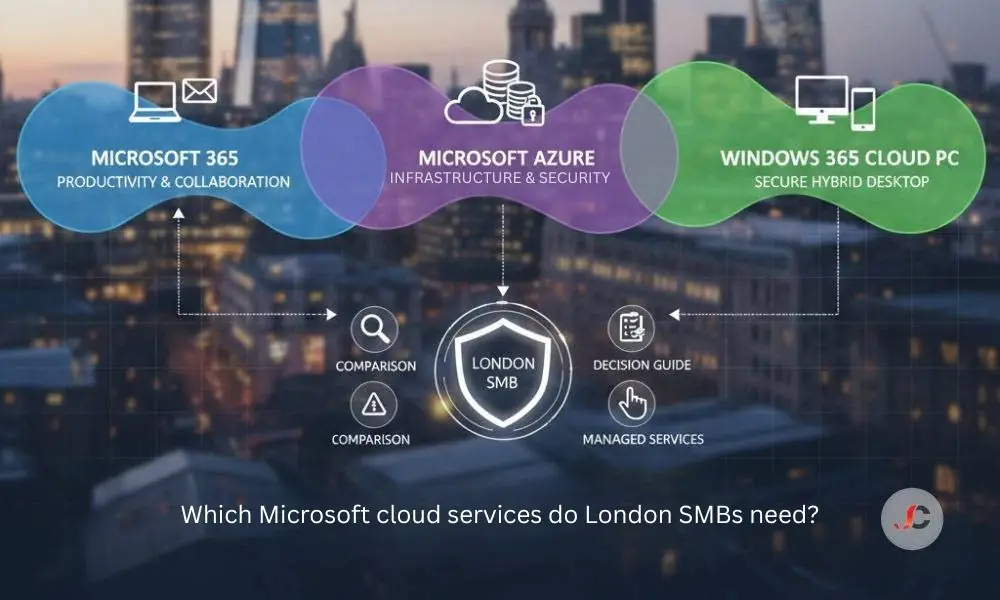
This guide explains which Microsoft cloud services London SMBs need by comparing the core platforms and linking them to common business scenarios in the capital. The goal is to help you choose a clear, practical strategy that makes the most of Microsoft’s feature-rich Azure platform.
Essential Microsoft Cloud Services London SMBs Need
For many London SMBs, the choice centres on three key platforms: Microsoft 365, Microsoft Azure, and Windows 365 Cloud PC. Each plays a different role, but together they can be combined to build a strong, joined-up cloud environment. Getting clear on what each one does is the first step towards making the right cloud decisions.
Microsoft 365: The Modern Digital Workplace
Microsoft 365 is the most familiar cloud service, primarily functioning as a Software-as-a-Service (SaaS) solution. It focuses on modern collaboration, productivity, and communication, providing the essential tools employees use daily. It is designed for simplicity and immediate utility.
For an SMB, Microsoft 365 offers the following core benefits:
- Ubiquitous Productivity: Use Word, Excel, PowerPoint and Outlook across all your devices.
- Team Collaboration: Tools such as Microsoft Teams for communication and SharePoint for file sharing and intranet sites.
- Built-in Security: Includes essential security features such as multi-factor authentication (MFA) and data loss prevention (DLP), critical for London businesses managing sensitive client data.
- Predictable Costing: It operates on a per-user, per-month subscription model, allowing for predictable budgeting and easy scalability.
Microsoft Azure: The Foundation for Scale and Customisation
Microsoft Azure is a massive, flexible collection of over two hundred Infrastructure-as-a-Service (IaaS) and Platform-as-a-Service (PaaS) solutions. Rather than providing ready-made applications, Azure offers the building blocks—computing power, networking, storage, and databases—required to construct, deploy, and manage custom applications and infrastructure in the cloud.
Use Azure when your business needs more than the usual productivity apps:
- Custom Application Hosting: Running custom or industry-specific line-of-business applications.
- Data Backup and Disaster Recovery: Providing reliable, geo-redundant storage and quick recovery to support business continuity in a significant financial centre.
- Advanced Networking and Security: Setting up tailored virtual networks, firewalls, and security operations tools.
- Infrastructure Replacement: Migrating on-premises servers, domain controllers, or confidential data centres to the cloud.
Windows 365 Cloud PC: The Hybrid Work Enabler
Windows 365 Cloud PC is a newer offering that delivers a complete, personalised Windows desktop experience to any device via streaming. This service, often used alongside Microsoft 365, is a Desktop-as-a-Service (DaaS) solution ideal for businesses embracing hybrid working models.
The Cloud PC provides significant operational advantages:
- Device Flexibility: Employees can access their work desktop, files and apps from personal laptops, tablets or thin clients.
- Enhanced Security: All processing and data storage stay in the cloud, reducing the risk of data loss if a device is stolen or fails.
- Simple Management: It simplifies IT management by treating PCs as licensed, easily provisioned cloud resources, eliminating the need to manage individual hardware. This is particularly valuable when managing a distributed London team across various co-working spaces and home offices.
Comparison: Matching Cloud Services to London SMB Needs
Choosing the right platform depends entirely on the business’s current maturity, security requirements, and strategic goals. Many SMBs require a hybrid approach that leverages the strengths of each platform. Deciding which Microsoft cloud services London SMBs need requires a detailed comparative analysis of complexity versus cost.
| Feature / Service | Microsoft 365 | Microsoft Azure | Windows 365 Cloud PC |
| Primary Use Case | Productivity, Email, Collaboration (SaaS) | Infrastructure, Custom Apps, Data Backup (IaaS/PaaS) | Secure Remote Desktop (DaaS) |
| Pricing Model | Per-user, per-month subscription (Predictable) | Pay-as-you-go, consumption-based (Variable) | Per-user, per-month subscription (Predictable) |
| Management Complexity | Low (Microsoft manages the service) | High (Requires configuration and ongoing optimisation) | Medium (Simple provisioning, but network required) |
| Ideal for SMBs | All SMBs need email and office tools | SMBs with custom applications, large databases, or complex infrastructure | SMBs with hybrid/remote teams and strict data security needs |
This comparative matrix clearly illustrates that while Microsoft 365 is the starting point for managing Microsoft 365 subscriptions and user-based productivity, Azure is required for the underlying infrastructure, and Windows 365 addresses the specific challenge of secure, flexible end-user computing. Evaluating TCO is a crucial step when determining which Microsoft cloud services London SMBs need to maintain profitability.
Cloud Service Selection by Business Scenario
It becomes easier to see which Microsoft cloud services London SMBs need when you map each platform to real-world business challenges.
Scenario 1: New Start-up Requiring Productivity Tools
A new London-based start-up with ten employees requires professional email, collaboration, and document storage from day one. They have no existing servers or custom software. The answer to which Microsoft cloud services London SMBs need is straightforward: Microsoft 365.
Recommendation: Microsoft 365 Business Premium.
This plan includes business email, Teams and cloud storage, along with extra security to support a professional setup. It is priced per user, which suits most start-up budgets.
Scenario 2: Established Business Needing Custom Applications and Backup
An engineering consultancy with fifty staff and a firm reliance on a custom database application needs to replace its ageing on-premises server room. They require available data storage and a robust backup solution. For businesses like this, identifying which Microsoft cloud services London SMBs need focuses heavily on the Azure platform.
Recommendation: Microsoft 365 (for users) PLUS Microsoft Azure (for infrastructure).
The user-facing productivity remains on Microsoft 365. The database application, however, should be migrated to fully supported Microsoft Azure services—an Azure Virtual Machine or a PaaS solution like Azure SQL Database—to guarantee the performance and redundancy required. This split-service approach provides the stability needed for critical operations.
Scenario 3: High-Growth Firm Embracing Hybrid and Remote Work
A marketing agency with a hybrid workforce uses personal or leased devices. They must comply with strict data security requirements, ensuring no client data is ever stored on local hard drives. Consider both data residency and user access when deciding which Microsoft cloud services London SMBs need for your remote team.
Recommendation: Microsoft 365 (for applications) PLUS Windows 365 Cloud PC.
By implementing secure Windows 365 Cloud PC solutions, the business ensures that the entire desktop environment, including all sensitive files and applications, is streamed from the cloud. The employee enjoys a seamless experience while the company retains complete control over the data, which never leaves the secure Microsoft environment.
The Strategic Importance of Managed Cloud Services in the UK
Regardless of the Microsoft cloud combination selected, London SMBs must recognise the ongoing operational commitment. The cloud is not a set-and-forget solution. It requires continuous management, cost optimisation, security monitoring, and adherence to UK compliance. Proper management ensures that the answer to which Microsoft cloud services London SMBs need remains beneficial over time.
This is where working with a Managed Service Provider (MSP) really matters. An MSP delivers fully managed cloud services, acting as a partner to keep your platforms securely configured and running efficiently. On Azure, this is especially important given its consumption-based pricing and complexity—without active management, costs can rise quickly, and security gaps can appear.
Effective managed services address several key areas:
- Security Posture: Initiative-taking monitoring to guard against evolving threats, ensuring adherence to the Zero Trust principles championed by Microsoft.
- Cost Governance: Continuous monitoring and optimisation of Azure resources to prevent unnecessary spending.
- Compliance: Ensuring data residency and access controls meet UK legal requirements, including the Information Commissioner’s Office (ICO) guidance on cloud use.
The complexity of identity management, specifically the integration between on-premises Active Directory (if present) and the cloud-native Microsoft Entra ID (formerly Azure AD), is a critical area where expert assistance proves invaluable. This integration is vital for the security of all three cloud platforms.
Conclusion: Making the Right Cloud Investment
There is no single, fixed answer to which Microsoft cloud services London SMBs need, but a thoughtful, informed approach is crucial. All businesses benefit from the productivity tools in Microsoft 365, while adding Microsoft Azure for infrastructure and Windows 365 Cloud PC for end-user security, depending on specific operational needs in London’s competitive, regulation-focused environment.
Get expert advice to determine which Microsoft cloud services London SMBs need for your specific sector and growth plans. Start with core services and add Azure or Windows 365 when you need custom app hosting, backup, or secure remote access. A trusted local partner can manage Azure, support compliance, and help improve the resilience and efficiency of your cloud investment.
What are the primary ways Microsoft 365 and Azure serve small businesses differently?
Microsoft 365 is for productivity (email, Office apps); Azure is for infrastructure (hosting custom apps, servers, and data). Understanding this difference is key to knowing which Microsoft cloud services London SMBs need.
Is Microsoft 365 Business Premium sufficient for most London SMBs?
Yes, it is often enough, providing essential apps, strong security, and device management, but it does not cover complex Azure infrastructure needs.
How does Windows 365 Cloud PC fit into an existing Microsoft cloud strategy?
It provides a secure, streamed Windows desktop experience to any device, supporting hybrid workforces and integrating with both Microsoft 365 and Azure.
Which Microsoft cloud service is cheaper: Azure or Microsoft 365?
Microsoft 365 is generally cheaper and has a predictable, per-user monthly cost; Azure uses a variable pay-as-you-go consumption model.
What are the key compliance or data residency considerations for London businesses using the Microsoft cloud?
London businesses must ensure that their configurations comply with the UK GDPR, specifically regarding data residency options and access controls.